July 4, 2026
The quantum-from-scratch series is now a ten-episode animated playlist: a NumPy simulator built from nothing, amplitude bars you can watch interfere, and a classical on-ramp with the coin under the cup.
June 23, 2026
The very first useful thing our simulator did, back in post 0, was turn a vector of amplitudes into a vector of probabilities.
April 10, 2026
Across the series I kept saying the simulator was small: a qubit is an array, a gate is a matrix, the whole thing is a few hundred lines.
March 20, 2026
Every data silo follows the same architecture: domain files as ground truth, SQLite + FTS5 as a read-only cache, MCP as the query interface. After building five of these, the pattern is clear.
February 26, 2026
narro can now generate audio narration for Hugo blog posts, with synchronized sentence highlighting in the browser. The alignment problem turned out to be more interesting than expected.
February 24, 2026
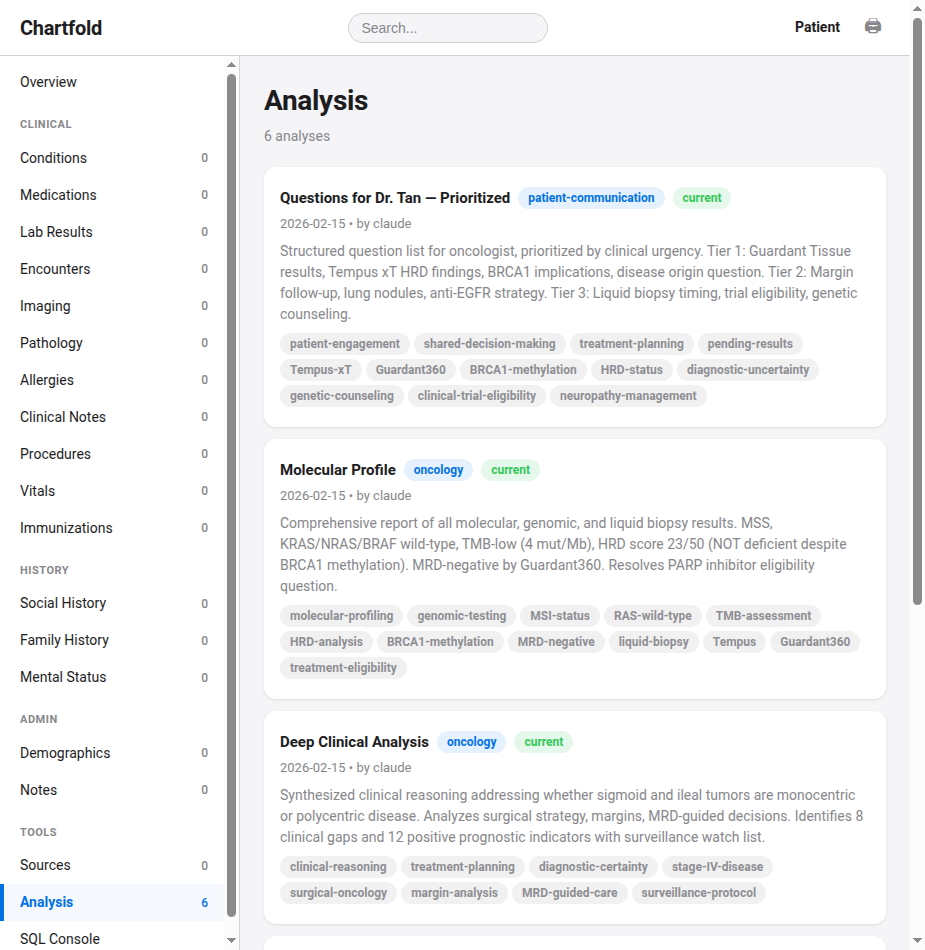
A walkthrough of Chartfold, a Python tool that loads your medical records into SQLite and exposes them to Claude via MCP for structured analysis, visit prep, and ad-hoc queries.
February 15, 2026
dapple is a terminal graphics library with one Canvas API, seven pluggable renderers, and eleven CLI tools for displaying images, data, video, math, and more.
February 14, 2026
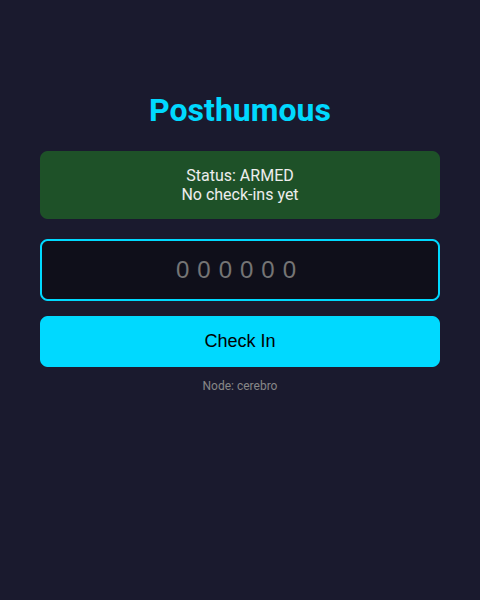
A walkthrough of Posthumous, a self-hosted dead man's switch that monitors periodic check-ins via TOTP, progresses through escalating alert stages, and triggers automated actions if you stop responding.

February 13, 2026
A guided tour through my open-source ecosystem: encrypted search theory, statistical reliability, Unix-philosophy CLI tools, AI research, and speculative fiction. How the projects connect and where to start.
February 13, 2026
pagevault turns any file into a self-contained encrypted HTML page. No backend, no JavaScript libraries, no external dependencies. Just AES-256-GCM and the browser's built-in Web Crypto API. The interesting part is making it work at scale.
January 26, 2026
Last post was the bad news: a real qubit leaks its coherence into the environment and forgets what it was doing.
January 20, 2026
longecho evolves from specification to implementation with build, serve, and manifest features.
January 20, 2026
Expanding the Long Echo toolkit with photos and mail, building toward longshade, the persona that echoes you.
January 19, 2026
Expanding the Long Echo ecosystem with photo and mail archival. Your memories and correspondence deserve the same preservation as your conversations and bookmarks.
December 18, 2025
Graceful degradation made concrete: years of bookmarks exported to a self-contained HTML app that works offline, forever.
December 16, 2025
Three CLI tools for preserving your digital intellectual life: conversations, bookmarks, and books. SQLite-backed, exportable, built to outlast the tools themselves.
December 16, 2025
A Python library for symbolic computation with a readable DSL, pattern matching, and a security model that separates rules from computation.
December 16, 2025
A CLI tool for cross-posting content to dev.to, Hashnode, Bluesky, Mastodon, and more, with LLM-powered auto-rewrite for short-form platforms.
December 16, 2025
A metadata index that gives LLM tools like Claude Code awareness of your entire repository collection.
December 16, 2025
Define statistical models symbolically and automatically derive score functions, Hessians, and Fisher information. No numerical approximation.
December 3, 2025

December 3, 2025
A corpus-based language model using suffix arrays for O(m log n) pattern matching. The corpus is the model.
November 30, 2025
AlgoGraph is an immutable graph library for Python with pipe-based transformers, declarative selectors, and lazy views.
November 30, 2025
A database-first bookmark manager with hierarchical tags, content caching, and NLP auto-tagging. Part of the Long Echo toolkit.
November 30, 2025
A framework for querying structured JSON documents using fuzzy logic, producing degree-of-membership scores instead of binary relevance.
November 30, 2025
A tool that converts source code repositories into structured, context-window-optimized Markdown for LLMs, with intelligent summarization and importance scoring.
November 30, 2025
A Python library for rule-based term rewriting with pattern matching, multiple input formats, and an interactive REPL.
November 13, 2025
Last post ended with a warning: the off-diagonal coherences of a density matrix are the fragile part, and a real qubit loses them on its own.
October 20, 2025
How I turned scattered data managers into navigable systems using virtual filesystems and POSIX commands.
October 13, 2025
EBK is a comprehensive eBook metadata management tool with AI-powered enrichment, semantic search, and knowledge graphs. Part of the Long Echo toolkit.
October 12, 2025
A virtual POSIX-compliant filesystem using content-addressable DAG storage with SHA256 deduplication.

October 9, 2025
A plugin-based toolkit for managing AI conversations from multiple providers. Import, store, search, and export conversations in a unified tree format. Built for the Long Echo project.

October 8, 2025
A logic programming system that alternates between wake and sleep phases, using LLMs for knowledge generation during wake and compression-based learning during sleep.
October 6, 2025
ZeroIPC treats shared memory not as passive storage but as an active computational substrate, bringing futures, lazy evaluation, reactive streams, and CSP channels to IPC with zero-copy performance.
August 30, 2025
Every state in this series so far has been a single vector with definite amplitudes.
July 15, 2025
27 image commands, one constraint: read JSON, write JSON. The closure property as a generative design principle.
June 17, 2025
This post does not add a quantum idea.
April 19, 2025
April 4, 2025
This is the one everyone has heard of: the algorithm that factors integers in polynomial time and, if a big enough quantum computer is ever built, breaks RSA.
January 20, 2025
The last post built the Quantum Fourier Transform and promised it was a readout instrument.
December 20, 2024
A streaming data processing system implementing boolean algebra over nested JSON structures, with lazy evaluation, S-expression queries, and memory-efficient windowed operations.
December 18, 2024
A command-line implementation of relational algebra for JSONL data with full support for nested structures, schema inference, and composable pipelines.
December 15, 2024
A composable ecosystem of tools for manipulating nested data structures. From a simple helper function to a full data algebra, guided by purity, pedagogy, and the principle of least power.

December 1, 2024
Applying Monte Carlo Tree Search to large language model reasoning, with a formal specification of the algorithm.
November 20, 2024
A Lisp-like functional language designed for network transmission. JSL makes JSON serialization a first-class design principle, so closures, continuations, and entire computation states can travel over the wire.
November 7, 2024
The last three posts built circuits whose payoff was a single global fact read out by interference.
August 24, 2024
Deutsch-Jozsa and Bernstein-Vazirani solved artificial promise problems.
June 21, 2024
An immutable-by-default tree library for Python with composable transformations, pipe-based pipelines, and pattern-matching selectors.
June 11, 2024
So far the qubits have mostly sat still.
March 29, 2024
In post 0 a qubit was a unit vector in $\mathbb{C}^2$, and everything about it fit in a length-two array.

March 15, 2024
A tiny autodiff library for understanding how backpropagation actually works.
January 15, 2024
I wanted to understand quantum computing properly, which for me means building the thing rather than driving a framework that does the linear algebra in the basement and hands back an answer.
January 8, 2024
Before the qubit, the ordinary object it edits: classical probability as vectors and stochastic matrices, and the one rule (weights never go negative) that quantum information breaks.
October 15, 2022
Define patterns, define replacements, repeat until done. Watch a 90-line rewrite engine learn to differentiate.
June 12, 2016
Three Python approximations of a random oracle, each showing a different tradeoff between true randomness, determinism, and composability.