Most of calculus is one idea, held up to the light and turned slowly. This is a seven-episode animated playlist that does exactly that: it starts from approaching and never really leaves it.
The idea is the limit. Watch a run of guesses close in on a value they may never quite land on, and you have the whole engine. Everything after is that same move, seen from a new angle. The derivative is a limit: shrink an interval until a secant line becomes a tangent, and its slope is an instantaneous rate of change, the amount a function stretches a tiny nudge as it passes through a point. The chain rule is what happens when those stretch factors are stacked in stages: the rates multiply, like meshed gears. The integral runs the whole thing backward, adding up a rate over its domain to recover a total, an area built from infinitely many infinitely thin slices. The fundamental theorem then closes the loop and shows that the derivative and the integral were two views of one object all along: differentiate an accumulation and the original rate comes straight back.
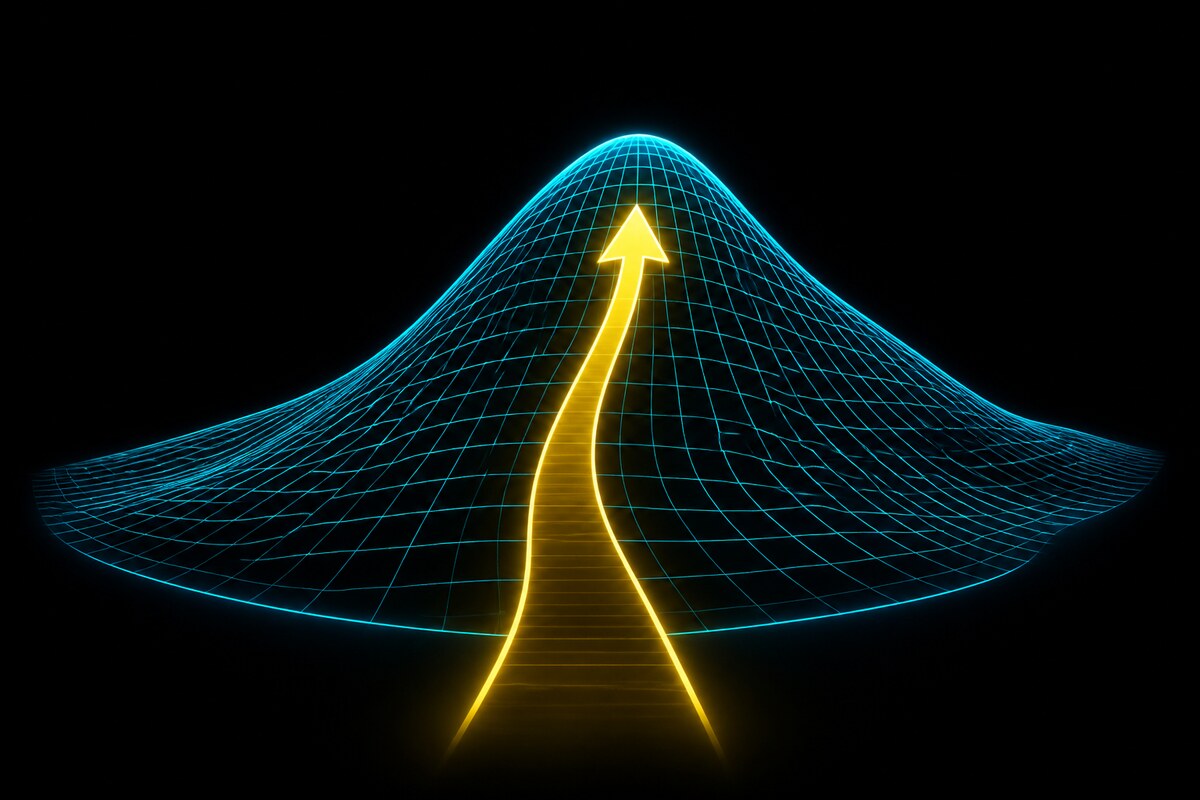
The last two episodes let the world have more than one direction. In many dimensions the slope grows into the gradient, a vector pointing straight uphill, and the second derivative becomes curvature; a peak is simply where the uphill direction vanishes. Optimization is the art of getting there when you cannot solve for that point directly: step along the gradient, over and over, or use the curvature to leap. That last pair is the ground under a great deal of applied mathematics, from fitting a model to its data to training a neural network.
Each episode is narrated and animated, math spoken as plain English rather than read off as symbols, and each one is deliberately load-bearing for the series that follow. If you have ever felt that calculus was a pile of unrelated rules, this is the argument that it is one subject, built from one idea.
The playlist
Open the playlist on YouTube (7 episodes)
Discussion