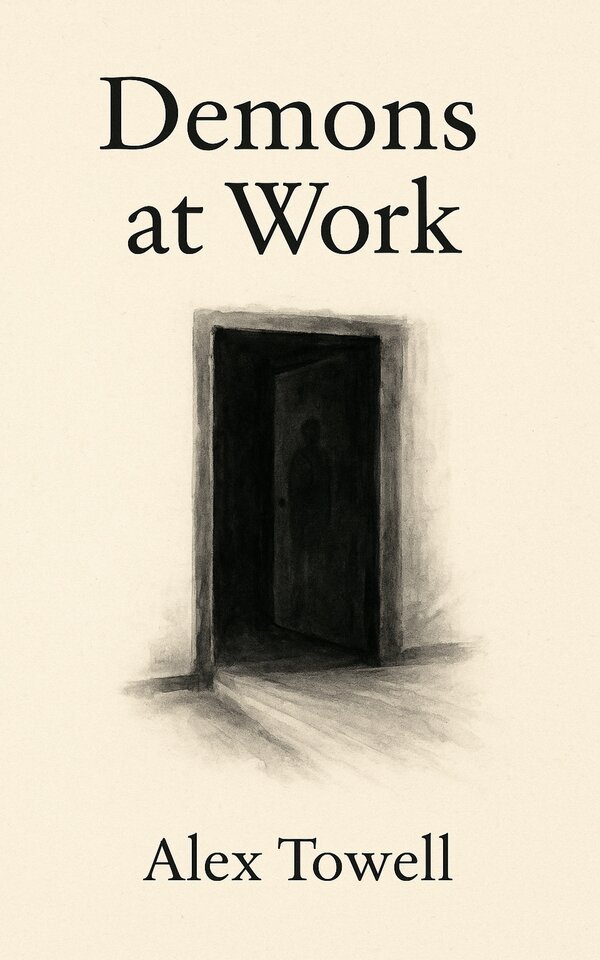
There is a moment in almost every haunting movie where an attentive viewer should get suspicious. The demon has been in the house for weeks. It can move objects, kill the lights, throw a grown man into a wall, speak in a voice that seems to come out of the plaster. By any honest accounting it could end the person it is tormenting at any time it wants. Instead it spends the whole film on atmosphere. Cold spots. A door that swings open on its own. A shape at the end of the hall that is gone the second you look straight at it. If the point were to collect a soul, this is a remarkably slow way to get there. So why the theater?
The answer the genre never states out loud is that the scaring is not a means to anything. The scaring is the job. Someone, somewhere back in the machinery, is graded on it.
That is the small observation the book grew out of. Take it seriously for a minute and the demon stops being a monster and turns into something more recognizable: an employee. He has a desk, or the idea of one. He reports to the Hauntings department. He has targets that were set by people who have never crouched in a dark corner at three in the morning waiting for a mark to glance over. He has a craft, and a quiet pride in it, and no acceptable way to voice that pride, because the thing he is skilled at is frightening a stranger in his own home.
I find that situation more interesting than any monster, because it is not really about demons. It is about a very ordinary predicament: being good at work you cannot defend. Most jobs that harm people are not staffed by villains. They are staffed by professionals who are competent, conscientious, and slightly proud of their competence, working inside a structure that points all of that skill at an outcome none of them would choose on their own. The harm is not in the craftsmanship. The craftsmanship is often real and admirable. The harm is in what the craftsmanship is aimed at, and the person doing the aiming rarely gets to pick the target.
Two books sit behind this one.
The first is Camus on Sisyphus. Sisyphus is sentenced to roll a boulder up a slope and watch it fall back, over and over, with no end. Camus reads that sentence as a portrait of labor itself, and the figure he lingers on is not the straining man mid-push. It is the man walking back down the hill, the empty stretch between one effort and the next, when there is nothing left to do but be aware of what he is doing. That interval is where a person is either free or not. My demon has that walk every night. He clocks in. He sets up his effects. He performs. He clocks out. The horror is genuine, and it is also a shift with a beginning and an end.
The second is Ishiguro. The Remains of the Day is narrated by a butler, Stevens, who has poured his whole life into the ideal of service, into being flawless at a role, and who cannot allow himself the question of whether the house he served with such devotion was worth serving. What makes the novel land is that Stevens never steps outside his own performance, not even in private, not even in his own narration. The reader sees past him. He does not. I wanted a narrator built the same way: earnest, capable, wholly inside his trade, and funny for exactly the reason Stevens is quietly heartbreaking, because he has no idea how he sounds. He is not performing irony for you. He believes every word.
Then the assignment lands. Demons at Work drops the demon into a 1920s bungalow with the sort of acoustics a haunter fantasizes about, a place where sound travels and the floorboards do half the work for him. The occupant is a widower named Gordon, a retired English teacher, several months into the loss of his wife. It looks like the job of a lifetime. Then the demon notices something that reframes all of it. One evening a week, Gordon sits and reads out loud from the book his wife had been in the middle of, resuming from the page her marker still holds. He is reading to a room with no one in it. To her.
Consider what that does to the demon’s work. The dread he manufactures now has to compete with a grief that was already living in the house, that is truer than anything he can build, and that Gordon is going to credit for every strange feeling anyway. His finest effects get absorbed into the man’s mourning and vanish without a trace. His rival is not another haunter. His rival is the sorrow that got there first, and it is winning.
I won’t say how he responds, or where it ends. What I will name is the question the whole thing turns on. When the numbers you are measured against track nothing that exists, when the purpose of the system is something you could never justify to the person on the other end of it, and when that person is right in front of you, close enough to understand completely if you let yourself look, what is left of doing the work well? Is the care you bring a kind of dignity, or is it a way to avoid asking the question at all?
I do not answer that in the book, or here. I do not think it has a clean answer. It is the same knot Camus leaves you holding, and the same one Ishiguro refuses to untie for Stevens. The demon’s version is only stranger because the harm is so literal and the professionalism so sincere. He is good at this. He knows the job does not accomplish what he is told it accomplishes. He does it well anyway, because doing it well is the one part he was allowed to keep.
The horror in the novelette plays it straight. The comedy comes entirely from the backstage view, from a competent professional narrating his own methods with the seriousness of a tradesman who loves his tools. He has no clue that he is funny, which is the only reason he is. Underneath the jokes it is a book about a thing most working people recognize and few say out loud: you can give real skill and real care to something and still not be able to look squarely at what it is for.
Discussion