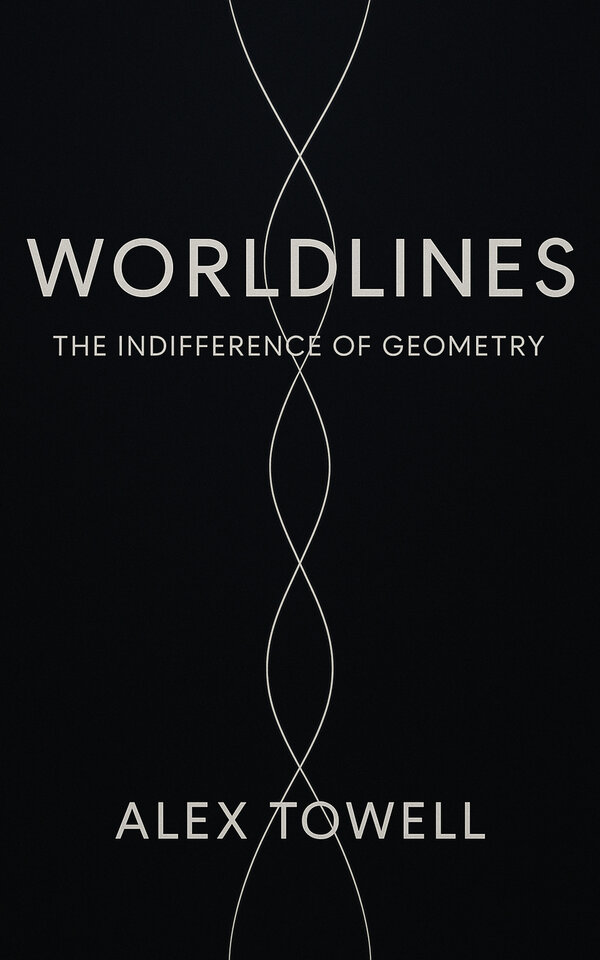
Relativity usually arrives as a set of corrections. Fast clocks run slow. The satellites that feed your phone its position need their onboard time adjusted or the map drifts you into the wrong lane. Mass bends the path of a light ray. Taught this way it is a recipe: feed in a velocity or a gravitational field, get a more accurate number out the other side. What almost nobody does with it in public is take it as a description of what is actually there. Not a sharper tool for predicting measurements, but a claim about the shape of the real. That is the one thing I wanted Worldlines to do, and to keep doing after the picture stopped being comfortable.
Three settled facts
The whole book rests on three results, and all three are ordinary physics, confirmed to more decimal places than almost anything else we know.
The first is that light travels at one fixed speed for every observer, however fast that observer is moving. Chase a light beam at nine tenths of that speed and it still outruns you at the full value, not at a tenth of it. This sounds impossible and it is measured daily.
The second is that gravity is not a force reaching out to pull on things. It is the curvature of spacetime, and a falling object is not being tugged, it is coasting along the straightest line available in a geometry that nearby mass has bent. Weight is what you feel when the ground stops you from following that line.
The third is about order. The early universe sat in a state of staggeringly low entropy, far more ordered than it had any statistical right to be, and everything we call the direction of time is the long relaxation away from that beginning. Physicists call the assumption the Past Hypothesis. It is doing quiet work under every other fact.
None of this is contested. The book contains no speculative physics, and neither does this essay. What is already confirmed is strange enough.
Now is not a place we share
Take the first fact and lean on it. If light has the same speed for everyone, then two observers moving relative to each other cannot agree on which distant events happen at the same time. This is the relativity of simultaneity, and it is not an illusion or a measurement error. Each observer carves spacetime into slices of “now” at a different tilt. Draw it: your line of the present and a passing traveler’s line of the present cross at different angles, and an event that sits in your future can sit squarely in the traveler’s present.
Here is the pressure that puts on things. If that event is already present for some perfectly ordinary observer, and no physics singles out one observer as the true one, then the event is as real as anything you would call happening now. Run the argument across every pair of observers, everywhere, and the future and the past both fill in. Every event is equally real. There is no moving spotlight of the present crawling from what was into what will be. There is a fixed four-dimensional whole, laid out once, and physicists call it the block universe.
Your life is a curve inside that block. A worldline, running from one end of you to the other, already drawn, every moment of it sitting at its coordinates whether you have reached it yet or not. Nothing about the geometry moves. The moving is something you do along the curve, not something the curve does.
Why it still feels like flow
If it is all already there, why does time feel like a current? The third fact carries the answer. The reason you remember yesterday and not tomorrow, the reason a dropped glass scatters but never reassembles, the reason effect trails cause, is that entropy was low at one end of the whole thing and climbs as you move away from it. The arrow you feel is not the geometry flowing. It is the gradient of disorder, read from the inside by a system that records its passage as memory. You are a worldline that processes its moments in sequence and lays down a track as it goes. The flow is real as an experience and absent as a feature of the map.
Living on a worldline
The physics is the tractable part. The unsettling part is that you are one of the curves being described.
A choice you have not made yet is already sitting at its place in the block, settled, part of the fixed pattern. That is not the same as being a puppet. The deliberation is real, it is stitched into the structure, your weighing of the options is exactly what the worldline passing through that region consists of. What it is not is open, if open means the future is genuinely undecided and waiting on you. It is decided the way the far side of a mountain is decided before you walk around it. You still have to walk.
Death changes shape too. It is an edge of your worldline, a place where the curve stops, and no moment of your life is more or less real for lying before that edge or beyond where the edge falls. The people whose worldlines ran beside yours are not deleted when their curves end. Their stretch of the block is permanent. That chapter I wrote slowly, because the honest version is neither the tidy consolation nor the flat despair people grab for first.
And the self, the continuous “I” that seems to run unbroken from childhood to the reading of this line, turns out to be a property of the curve, not a passenger seated on it. There is no extra rider carried from one moment to the next. There is the curve, and the curve holding a record of its earlier parts.
Where it lands
You could stop at that and call it cold, and the geometry gives you no argument against doing so. The structure keeps no record of whether the worldlines running alongside yours were met with care or cruelty. It weights nothing by worth. All of that holds. None of it is the final word.
The geometry does not imply that we owe each other anything. Nor does it rule the caring out. A worldline with care in it is a different object from one without, even though the geometry keeps no ledger of the difference. The caring does not come from the physics. It comes from us, or it comes from nowhere. We are, in the end, each other’s only refuge inside a structure that offers none of its own. I think the ending is earned and not tacked on, and I sat with it a long while before I let myself write it.
Worldlines is my first nonfiction book, and the first of the two nonfiction volumes at the heart of a project I call The Indifference Suite. It runs twelve chapters across two parts: the first, The Geometry, builds the three facts and traces the consequences they force, and the second, The Response, tries to live inside the result rather than flinch from it. Its companion volume, Multitudes, runs the identical argument through quantum mechanics instead of relativity, and lands on the same warmth from the other pillar of modern physics. If this one interests you, Multitudes is the second half of the same thought.
Discussion