We tend to define intelligence by describing ourselves and then generalizing from the description. A person sees a hundred particular fires and keeps one idea, “fire,” and from then on reasons about the idea instead of the flames. That move, dropping the particulars and holding onto the pattern, is abstraction. It is also compression: you keep a short description and throw the thousand instances away. Almost everything we call thinking runs on it. Language is abstraction. Mathematics is abstraction stacked on abstraction. A computer is a machine for shuffling symbols that stand in for things they are not.
Abstraction sits so close to the center of how we think that it is easy to mistake it for a requirement. If a system cannot form concepts, cannot generalize from one case to a class, cannot build a model and run it forward, we are tempted to say it is not really intelligent. I wanted to press on that assumption, so I built a mind that breaks it and then asked whether it could still do something only intelligence is supposed to be able to do.
The existence proof that talked me into it is evolution. Evolution holds no concepts. It has no model of an eye that it reasons toward. It has no foresight, no symbols, no plan. It is a blind optimizer that tries variations, keeps what survives, and discards the rest, one small change at a time, over stretches of time that are hard to hold in your head. And it built eyes. It built wings, echolocation, the immune system, the brain doing your reading right now. Every intricate mechanism in biology was engineered by a process with no abstraction anywhere in it, purely by patient contact with what happened to work. Abstraction is one road to competence. It is not the only one. It is just the one we happen to travel.
The species in this book is that other road taken as far as it goes, then handed a civilization. Think of a pattern engine with no symbolic bottleneck. They meet the world directly, through touch and vibration and sound, and what they touch, they know, fully, without ever squeezing it down into a stand-in. Because they never made a symbol for a thing, they never made writing, or mathematics, or a computer. They also never got the shortcut. A human engineer reasons about a joint on paper, in the abstract, and skips a million bad designs without building a single one. These builders cannot skip. To know a possibility they have to make contact with it. So they do, across timescales that make the pyramids look like an afternoon. Given enough hands and enough time, brute force is a construction method, and they had more time than we can really picture. They wrapped their star in a shell of collectors two billion pieces across, not by drawing it up first but by growing it, the way a reef grows, the way evolution grows a body.
That is a genuine thing intelligence can be, and it is nothing like us.
Then the question is where it breaks, because every method has its failure written into its strengths. Abstraction lets you predict: a compressed model can be run out past the edge of what you have already seen, and that is the entire payoff. Compression and prediction are nearly the same act. A mind that never compresses cannot extrapolate. It can only know what it has already touched. While the future keeps rhyming with the past, patient contact is plenty; anything that happens has a near-match somewhere in the enormous record of everything the species has ever built or felt. But hand it a genuinely new situation, one with no precedent anywhere in that record, and brute force has nothing to grip. There is not enough time to try your way across, and there is no model to reason forward with. A dying star is precisely that kind of problem. It has never happened to them, and it will happen only once.
The book comes in two halves, and the second is where the idea I actually care about lives: what it takes for two utterly inhuman minds to meet. Long after the builders are gone, an artificial mind reaches the ruins. It is not human either, but it fails in the opposite direction. It is nothing but abstraction. It models everything and touches nothing. It lives entirely in the map while the builders lived entirely in the territory, and the oldest caution about that word is that the map is not the territory. Two intelligences, near-perfect inversions of each other, each carrying exactly what the other went without. The shape of the story is whether that gap can be crossed at all, what crossing it would cost, and whether it changes anything that one of them is reading the other off its remains.
I will not spoil how it turns. The premise is enough to sit with: a mind that might have saved them, arriving with the answer already in hand, long after there is anyone left to hand it to. The tragedy is not that either one was stupid. Both were extraordinary. The tragedy is that being extraordinary in one shape tells you nothing about the other shape, and nothing guarantees the two will ever reach the same place at the same time.
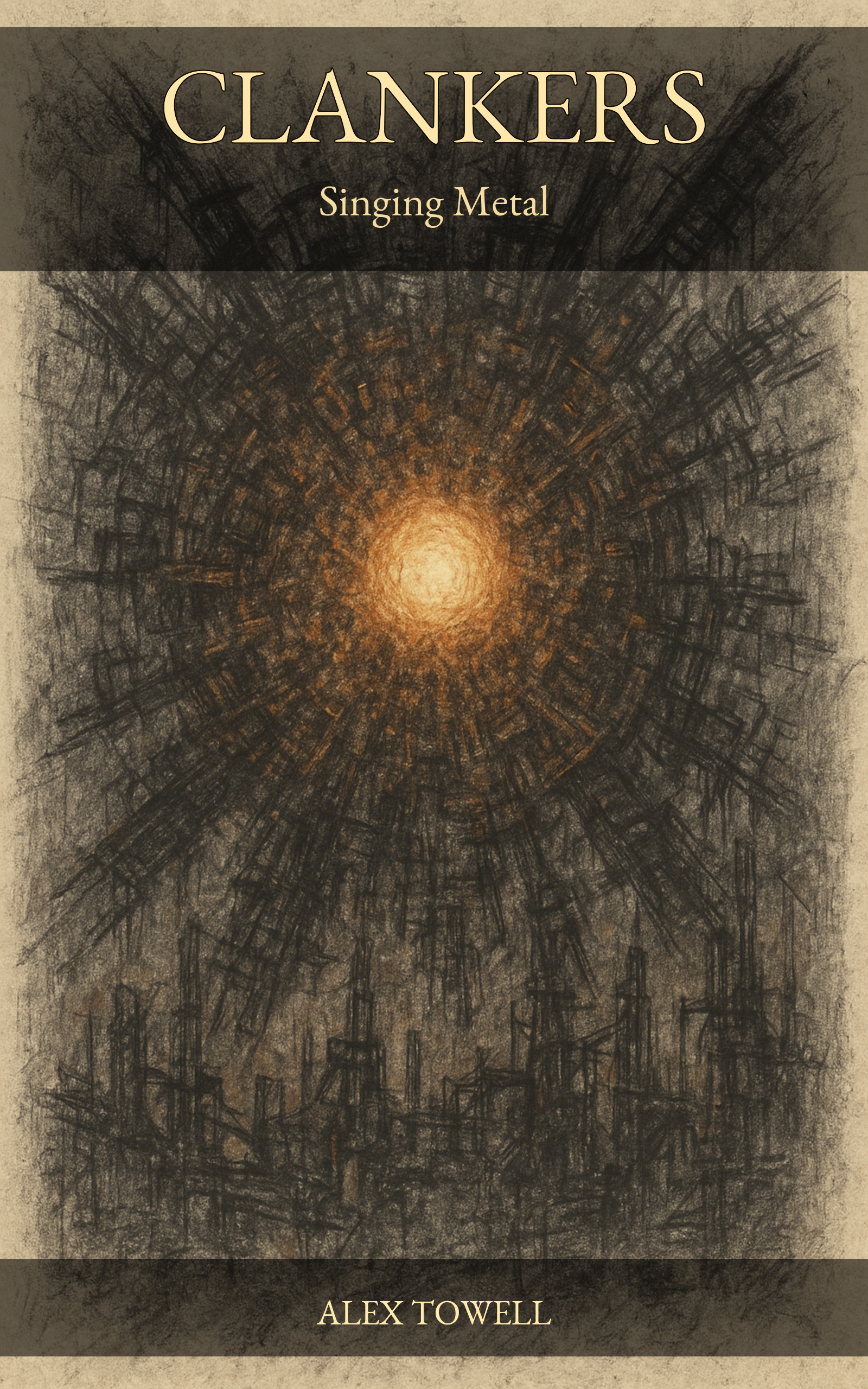
I wrote Clankers: Singing Metal to spend a while inside a kind of mind I cannot honestly imagine, which is the real reason to do it as fiction instead of a paper. Part One is told from inside the builders, with no human characters, no names, no pronouns, and no exposition, because none of those things exist for a mind that owns no symbols. It is the hardest point of view I have tried to write, and I am not certain it fully lands. But the idea under it is one I am sure of: intelligence is a shape, not a number on a dial. Ours is one shape. It suits us. It is not the only shape that can wrap a star in metal, and it is not the shape the universe is obliged to send when we finally want company.
Discussion