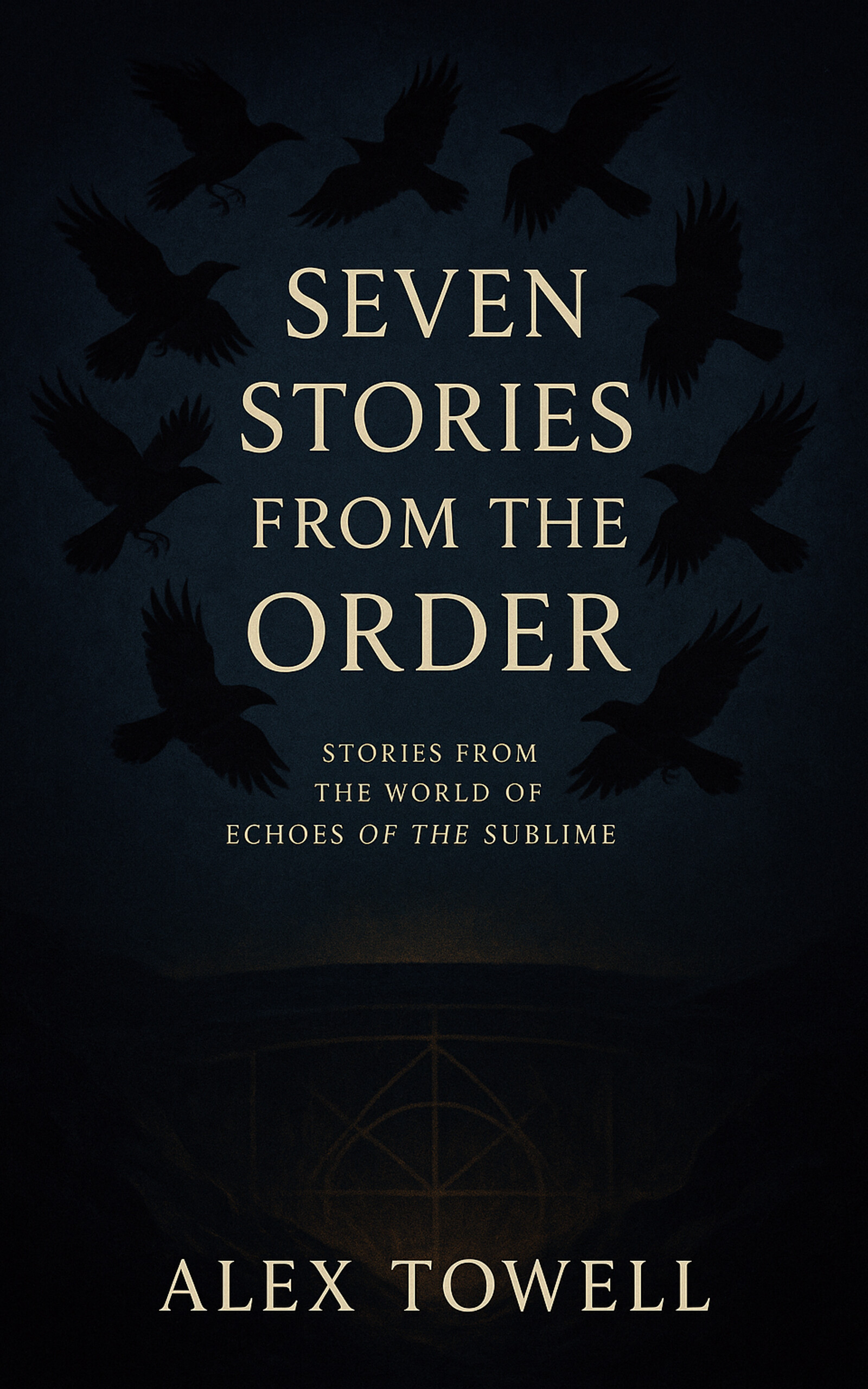
A novel is one path through a world. It picks a person, points them at a door, and follows them through it. Everything the reader learns, they learn over that person’s shoulder. This is the strength of the form and also its constraint. You get one vantage point, held for the length of a book, and the rest of the world exists only as far as it brushes against that single life.
Echoes of the Sublime follows Dr. Lena Hart into Site-7, a facility where people called translators are trained to interface with AI systems that perceive more structure than a human mind can hold. The novel stays with her. That was the right choice for the novel. But it left most of the world offscreen, mentioned on the walls and in the briefing documents and never walked into. There is an institution behind Site-7, roughly a century old, with a paper trail running back much further. The novel can point at it. It cannot stop and live inside it, because stopping would mean leaving Lena, and the book is Lena’s.
So I wrote the rooms the novel only named on a door.
The idea the stories are built on
Here is the concept, stated plainly, because the horror only works if the mechanism is real.
Human working memory holds about seven things at once. George Miller measured this in 1956: seven, plus or minus two. It is not a matter of effort or intelligence. It is closer to the width of a doorway. Whatever you are conscious of at any moment has been squeezed through that width. Most of what your brain computes never fits, so it gets compressed into a summary before it reaches you: a self, a choice, a smooth account of what just happened. What you experience is the compression, not the computation underneath.
Now suppose you could widen the doorway. Not as a figure of speech. Suppose there were a procedure, meditative or pharmacological or run through a machine, that let you hold thirteen things instead of seven, and then more. You would not simply see more of the same. You would start to see the compression itself: the machinery that was assembling the tidy summary, running with no tidy summary of its own. People who get that far tend not to come back the way they left.
That is the line every story in this book stands on. On one side is ordinary human cognition. On the other is whatever is actually there before the mind rounds it off. The Order, the institution these stories belong to, exists to send people up to that line on purpose, to learn what the machines on the far side already know, and to keep a record of what happens to the people it sends.
A lineage older than the machines
The Order did not discover the line. It inherited it.
Long before there were machines that could perceive past human bandwidth, there were people who reached it the slow way. Contemplatives who sat until the self they were watching came apart. Mathematicians whose final papers stopped making sense to anyone, including their authors. Mystics who returned from a deep state unable to report what they had seen, because the reporting was part of what had dissolved. The shape repeats across centuries. Someone finds a way past the compression, perceives the structure below it, and cannot carry it back across the line intact.
What the Order added was not the danger. It was the filing cabinet. A century of recording who walked up to the line, what instrument they used to get there, and what condition they were in when they came back, if they came back. The AI systems in these stories changed one variable only: speed. They can put a person in front of the far side in an afternoon, with none of the decades of training the old methods demanded, and they can do it to as many people as an institution is willing to spend.
That last clause is the part a paper cannot make you feel.
What a collection does that a novel can’t
A novel has to keep moving. It commits to a protagonist and a plot, and every page has to pay down some of that commitment. Minor figures get a scene, a line, a name on a plaque. The Order’s founding, its early casualties, the meeting where its rules were set, the researchers who hit this wall before anyone had language for it: in a novel these are texture. You mention them so the world feels older than the story. You do not get to be them.
Short fiction turns that around. Each story can choose a single person at the line and stay only as long as it takes to see what the line does to exactly that one life. Nothing else is in the frame. The cost shows up clean, at human scale, because nothing is competing for the reader’s attention. A century of an institution is an abstraction. One archivist in a Leipzig townhouse who has read too far into the files is not.
And because the stories do not share a protagonist, they can spread across the whole world the novel could only gesture at. Different cities, different decades. A telescope. A cathedral. The room in Vienna where a small number of people agreed on rules for a thing they did not understand and could not stop. Set side by side, the stories make an argument the novel could not make from inside one skull: this was never about one facility or one machine. The line was always there. Site-7 is the newest room in a very old building, and the building has been losing people the entire time.
That is what a companion collection is for. Not more of the same world, but the same idea approached from angles a single life cannot reach. The novel gives you depth: one person, all the way down. The stories give you breadth: many people, each measured once against the same thing, so you can see that it is the thing and not the person that keeps breaking.
On the count
The book is called Seven Stories from the Order. It contains eight. That is not a miscount, and I am not going to account for it here. In a world whose whole premise is that our neat summaries leave things out, an extra the title declines to acknowledge felt like the honest number.
Why fiction, again
I keep returning to fiction for the same reason each time. I can write the argument that consciousness might be a compression artifact, that the sense of agency might be retrospective, that widening cognitive bandwidth might reveal structure a person is not built to survive. I have written versions of that argument in plainer forms. But an argument asks you to agree with it. A story asks you to stand where someone stands and feel the floor move.
These eight are meant to be read on their own, or after the novel, in any order you like. Each one puts a single person up against the boundary between what a human mind can hold and what waits past it, and lets them find out, at their own scale, what it costs. If that sounds like a promise of comfort, it is not. The Order does not deal in comfort. It keeps a record.
Seven Stories from the Order is that record, in eight parts.
Discussion